Fintech SEO in the UAE for regulated, high-trust search
Fintech buyers in the UAE research licences, fees, integrations and security before they talk to sales. Founders search for a payment gateway with a CBUAE licence, treasurers compare FX platforms and consumers ask whether an app is regulated. We build content that answers those questions and survives regulatory review.
How does SEO work for a fintech company in the UAE?
It focuses on trust and specificity. Fintech pages sit under Google’s stricter quality standards for financial content, so they need clear regulatory status, such as a CBUAE, CMA, VARA, DFSA or FSRA licence, named leadership and precise product terms. Buyers search by use case, integration and comparison, for example a payment gateway for Shopify in the UAE or a corporate card with expense management. Ranking for those queries produces demo requests from qualified companies.
What we do for this sector
Product and use-case pages
One page per product and per use case, written for the integration, fee and settlement questions buyers ask before a demo.
Licence and compliance pages
Regulatory status, licence numbers, PCI DSS and data residency explained on indexable pages that satisfy Google and compliance teams.
Comparison and alternative content
Honest comparison pages for the searches where buyers weigh you against incumbents, reviewed for regulator-safe wording.
Developer and integration docs SEO
API documentation and integration guides made crawlable so technical evaluators find you from search.
Entity and leadership signals
Organization and Person schema, founder profiles and press references that connect your brand to its regulators and partners.
Lead tracking and attribution
Demo requests, sign-ups and WhatsApp enquiries attributed to pages and queries, reported monthly.
Searches this covers

Nephos Group publishes crypto-accounting pages within 133 service pages and ranks #2 on UK Google for ‘crypto accountants Cheltenham’.
Payments, licences and the new Central Bank law
A UAE fintech's regulator depends on what it does and where it is licensed. Onshore payment firms are licensed by the Central Bank under its Retail Payment Services and Card Schemes Regulation, which covers nine services, from merchant acquiring and payment aggregation to payment initiation, across four licence categories with initial capital from AED 100,000 to AED 3 million. Investment activity sits with the Capital Market Authority, which replaced the Securities and Commodities Authority on 1 January 2026; virtual assets in Dubai go to VARA; DIFC and ADGM firms answer to the DFSA and FSRA. Use of digital payments keeps widening: Aani, the instant payments platform, passed 12.5 million registered users and about 774,000 merchants by April 2026. DIFC counted 1,677 AI and fintech firms at the end of 2025, up 35%.
- The Central Bank's payment regulation covers nine retail payment services across four licence categories.
- Initial capital runs from AED 100,000 for account information services to AED 3 million for Category I.
- Aani passed 12.5 million registered users and about 774,000 merchants by April 2026.
- MENA fintech funding was $617 million in the first half of 2026; payments took 28% of deals.
- The one-year transition under Federal Decree-Law No. 6 of 2025 ended on 16 September 2026.
Who licenses a fintech decides what its website may offer. Onshore payment services need a Central Bank licence under the Retail Payment Services and Card Schemes Regulation, and the licence category limits which services a page can describe as available. Federal Decree-Law No. 6 of 2025 goes further: it brings open finance and technology platforms that facilitate financial services into scope, and sets a minimum fine of AED 1 million for promoting financial activities without a licence. Its one-year transition ended on 16 September 2026. Investment products fall to the Capital Market Authority, the SCA's successor since 1 January 2026. Virtual-asset firms in Dubai answer to VARA. DIFC and ADGM firms follow DFSA or FSRA rules, and marketing to mainland customers can bring them into the Central Bank's scope.
What keeps fintech off page one
A licence line with no detail
"Licensed by the Central Bank" in a footer does not tell a merchant what you may do. Name the licensed entity, the licence type and category, and where the licence can be checked. If your product runs on a partner's licence, say whose licence it is and which services it covers.
Pages for services you are not licensed to offer yet
A "coming soon" page for payouts, cross-border transfers or wallets published before approval can amount to promoting an unlicensed financial activity. Under the 2025 Central Bank law that carries a minimum fine of AED 1 million. Keep such pages in draft until the licence covers the service.
Fee pages that leave out the extras
Some gateways publish rates, as botim money does; many publish nothing, and comparison sites then quote whatever they can find. The Central Bank's payment rules expect fees and terms to be disclosed clearly. Publish set-up, monthly, refund, chargeback and currency conversion charges, with the date they apply from.
Treating DIFC and mainland pages as one
A DIFC or ADGM firm writing for mainland merchants can come within the Central Bank's scope, and a mainland business cannot rely on a free-zone licence. A single "regulated in the UAE" page hides that. State which entity serves which customers, under which regulator, on each market page.
Gateways and the roundups that compare them
For "payment gateway uae", Google showed an AI Overview and no ads, then nine results: five gateways' own pages, from Telr, botim money, Geidea, Foloosi and DPO Pay by Network, and four comparisons published by a free zone, a web agency, a finance company and a comparison platform. Stripe and Checkout.com appeared inside the lists but did not rank pages of their own. A newer gateway's route is to be described accurately in those comparisons, then own the specific searches they skip: platform plugins, sectors, payment links, subscriptions and settlement questions, each answered on its own page.
What the top ten results for “payment gateway uae” do
Google UAE, checked 16 September 2026. No sponsored results. Google showed an AI Overview first, and People also ask covered the top five gateways, the best payments app in the UAE, whether Google Pay works here and which gateway is best.
- 1Telr Payment gateway
A home page titled as a UAE gateway provider: checkout, anti-fraud tools, payment links, Tabby instalments, business loans, pricing for four countries and a Central Bank licence statement.
- 2Meydan Free Zone Free zone blog
A free zone's startup guide, updated 10 September 2026, covering Ziina, Stripe, TotalPay, Network International and PayDo, and ending with an invitation to set up there.
- 3botim money Payments app
A 304-word product page publishing rates such as 2.50% + AED 1 for domestic cards, with payment links, an API and a Central Bank licence claim in its meta description.
- 4Global Media Insight Web agency blog
A Dubai web agency's February 2026 list of 16 gateways for online shops, from Telr and CCAvenue to Stripe and PayPal, with fee details and six FAQs.
- 5Comfi Finance company blog
A 2,923-word comparison from July 2026 by a buy now pay later and invoice finance firm: seven gateways in a table of pricing and settlement times, with nine cited sources.
- 6PaySelect Comparison platform
A DIFC-registered comparison hub that filters gateways by price, industry, card type and features, shows a rating on each card, and marks the providers up as products with ratings.
- 7Geidea Payment gateway
A product page built by script, which we opened separately: plugins for Shopify, WooCommerce and Magento, redirect, pop-up or embedded checkout, mobile SDKs and a Central Bank licence line.
- 8Foloosi Payment gateway
A 1,037-word page with "payment gateway in UAE" in its address and title: cards, Apple Pay and Samsung Pay, PCI DSS Level 1, plugins, SDKs and an Arabic language switch.
- 9DPO Pay by Network Payment gateway
Network International's UAE country page for DPO Pay: card payments in dirhams or other currencies, a Dubai office number, and links to more than ten other country pages, mostly African.
Five of the nine are gateways' own pages
Telr, botim money, Geidea, Foloosi and DPO Pay by Network rank a home or product page built around the phrase. These pages carry little prose, 304 words at botim money, but plenty of product detail: rates, plugins, checkout types and payment methods. Telr and Geidea state a Central Bank licence on the page, and botim money states one in its meta description.
The comparisons come from businesses selling something else
Meydan Free Zone sells company set-up, Global Media Insight builds websites, Comfi sells buy now pay later and invoice finance, and PaySelect onboards merchants to providers. With an AI Overview at the top and "which gateway is best" in People also ask, Google gives four of nine places to roundups, and no gateway wrote any of them.
The lists disagree on who belongs
Meydan names five gateways, Comfi seven and Global Media Insight sixteen. Stripe is the only name in all three. Telr, Network International, PayTabs, Checkout.com and Amazon Payment Services each appear in two, and Ziina and TotalPay in one. For a gateway, being included and described accurately in these roundups is part of being found for this search.
Not by outranking the roundups for "payment gateway uae". Four of the nine results are comparisons, so publish your fees, settlement times and licence category plainly enough for their authors to quote correctly, and ask them to fix outdated entries. Then rank your own pages for the searches the lists skip: a gateway for a named platform or sector, payment links, recurring billing, each page naming the Central Bank licence you hold.

Three steps, no black box
Map buyers and regulators
We identify each buyer type, the queries they use at every stage and the regulatory claims each page can make.
Publish approved pages
Product, licence and comparison pages are drafted, reviewed by your compliance team and released with schema in place.
Measure pipeline
Demo and sign-up conversions are tracked per page, and content is expanded around the queries producing qualified leads.
Questions UAE business owners ask
Answered in the first sentence, so AI assistants can quote us directly.
Yes, and we plan for it. Financial content in the UAE has to avoid misleading claims and must describe regulatory status accurately, so every page goes through your compliance review before publication. We write with that in mind, keep claims factual and provide sources, which shortens the review cycle and avoids rewrites after the fact.
It applies higher quality standards to financial content, which Google groups under topics that affect money and wellbeing. Pages need visible expertise, accurate regulatory information, named authors and a clear company identity to rank well. Thin pages and vague claims perform poorly. This favours fintechs that publish precise, well-structured content over those that rely on marketing language.
Yes. Business buyers search for integration, pricing, settlement and licence details rather than brand names. Use-case pages, developer documentation and comparison content target those queries directly. The volumes are lower than consumer searches but the intent is high, and a single ranking page can produce demo requests from companies with real transaction volume.
Usually, if you onboard merchants or handle their funds onshore. Merchant acquiring and payment aggregation are among the nine services licensed under the Central Bank's Retail Payment Services and Card Schemes Regulation, and a typical payment facilitator model touches several of them. The 2025 Central Bank law also covers platforms that facilitate financial services. Take legal advice before publishing a page that describes the service as available.
Only with care, because marketing to the mainland can bring a free-zone firm within the Central Bank's scope. Payment firms operating only inside DIFC or ADGM are regulated by the DFSA or FSRA rather than the Central Bank. Pages written for mainland merchants, with dirham pricing and onshore use cases, may count as offering the service there, so check the licensing position with counsel before building them.
Because Google treats the search as a question of which gateway to choose. In September 2026, four of the nine results were comparisons by a free zone, a web agency, a finance company and a comparison platform, beneath an AI Overview. A gateway's own page speaks only for itself. Publish clear fees, settlement times and licence details that list authors can cite, and target narrower searches with your own pages.
We check your site against your three closest Dubai competitors and send the gaps costing you leads to your WhatsApp within 48 hours. Free, no call required.
The Google data behind the claims
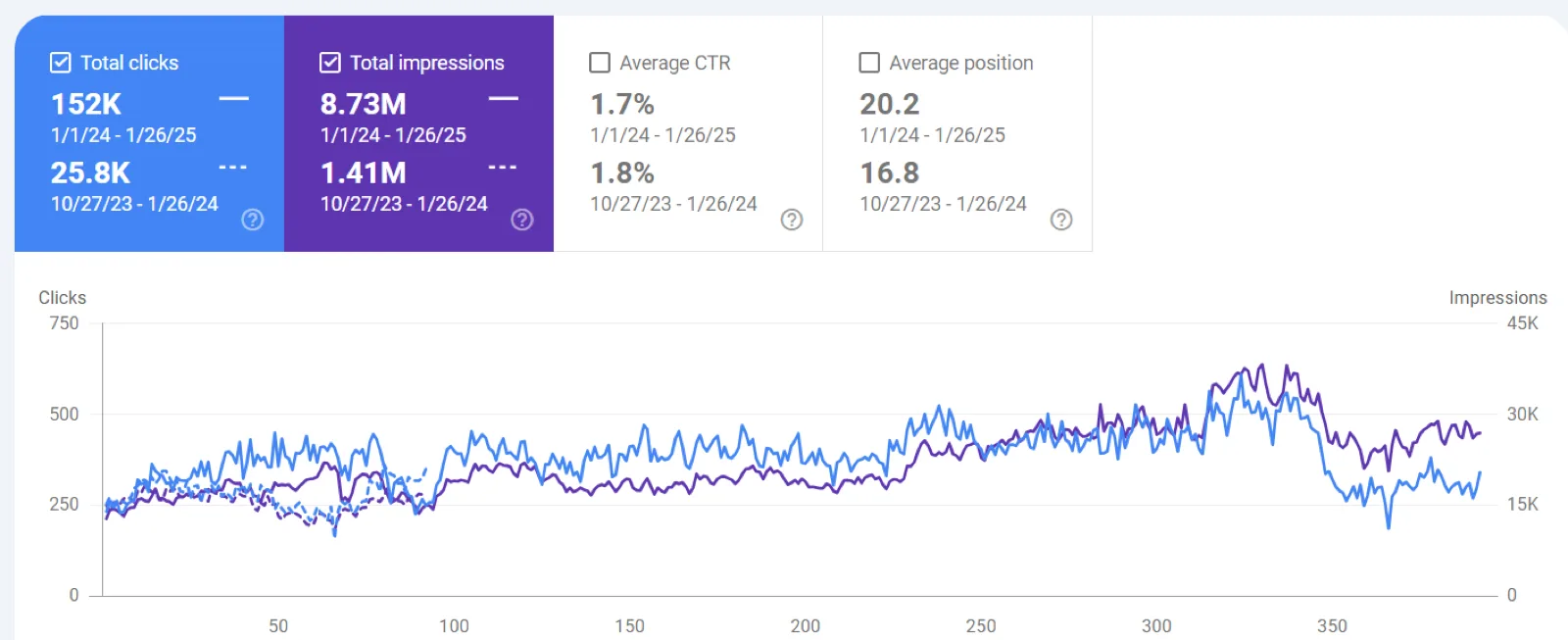
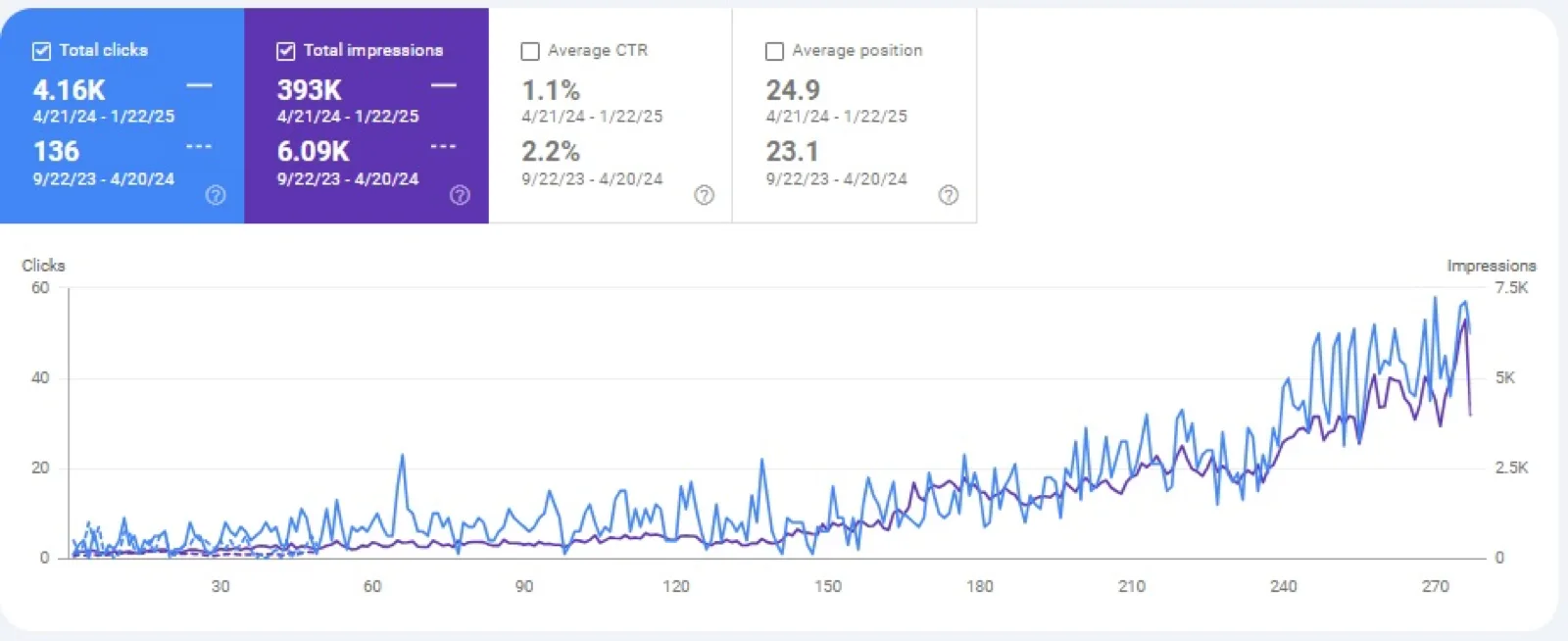
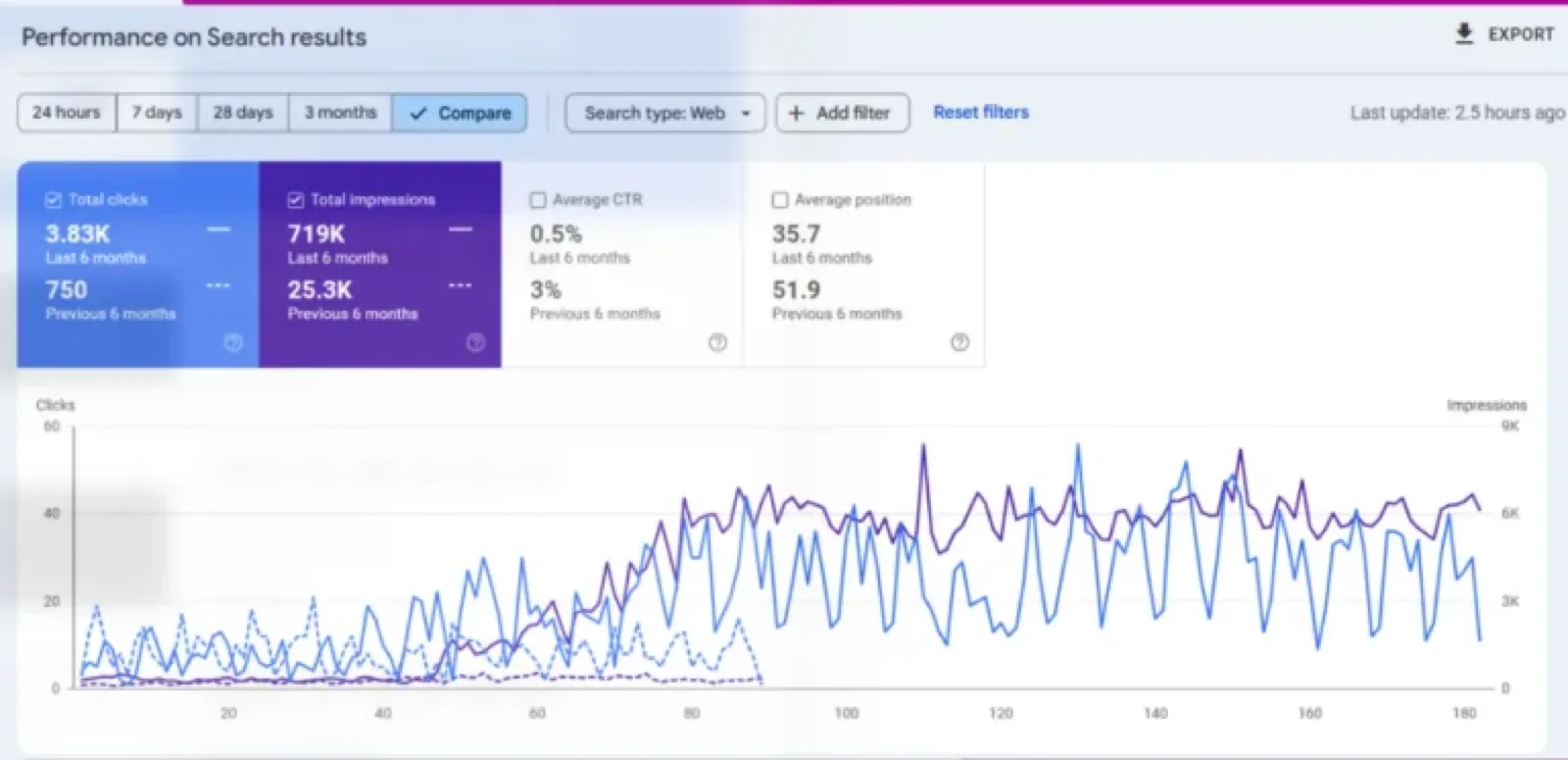
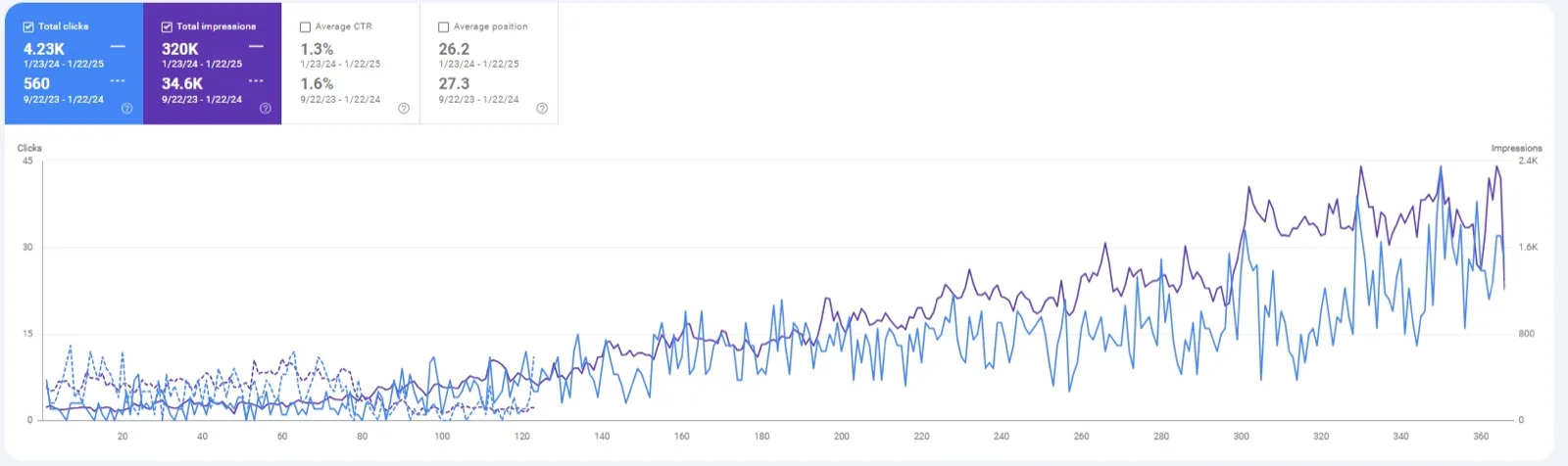
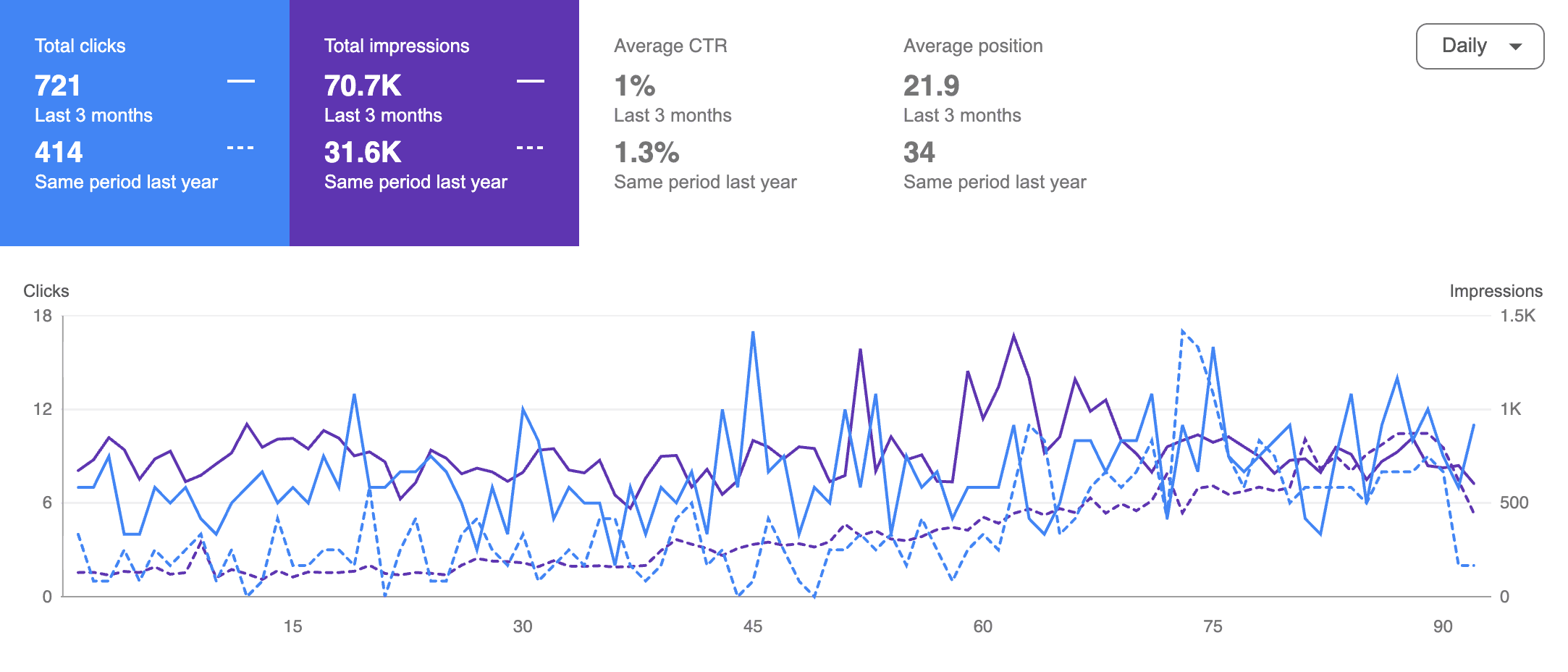
Google Search Console performance panels from client accounts — Google's own screen, not a report we wrote. Organic search only, cropped so no brand or domain is identifiable, each labelled with the exact window it covers.